Why your emails land in Promotions — and the fix
Deliverability is not one setting. It is authentication, list hygiene and engagement history working together. Here is the order to fix them in.
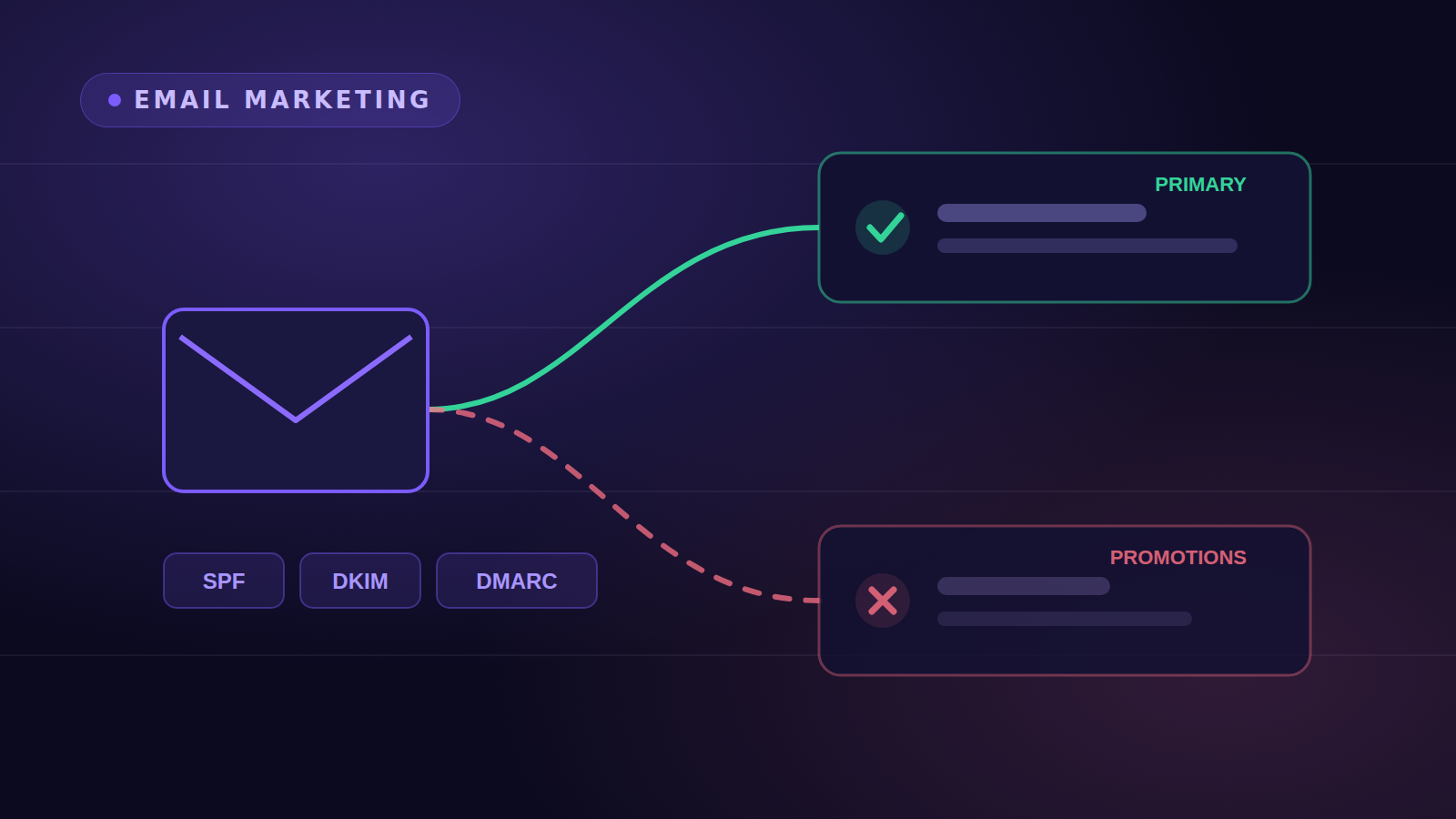
“Our open rates have collapsed” is one of the most common things a new client tells us. Nine times out of ten the campaign is fine and the delivery is not.
Inbox providers decide placement on a reputation score built from how recipients have historically treated your mail. Fixing it means working through the causes in the right order — there is no single switch.
Step one: authentication
SPF, DKIM and DMARC tell the receiving server that you are entitled to send as your domain. Since 2024, Google and Yahoo require all three from bulk senders. If DMARC is missing or set to p=none and never reviewed, you are starting every send at a disadvantage.
This is a DNS job, it takes under an hour, and it is non-negotiable.
Step two: stop emailing people who ignore you
This is the one clients resist, because the list gets smaller. But engagement is the strongest placement signal there is. Every send to someone who has not opened in a year teaches Gmail that your mail is unwanted — and that judgement is applied to the people who do want it.
Run a re-engagement sequence. Whoever does not respond gets suppressed. A list of 8,000 engaged subscribers will out-earn 40,000 stale ones, and it costs less to send to.
Step three: warm up properly
New domain or a long gap since your last send? Start at a few hundred of your most engaged contacts a day and build over two to three weeks. Going from zero to 50,000 in one send is the fastest route to the spam folder.
Step four: then look at the email itself
- A sensible text-to-image ratio — an email that is one large image is a classic spam signal.
- Links on a domain that matches your sender, not a random shortener.
- A visible, working unsubscribe link, plus a one-click list-unsubscribe header.
- Subject lines that describe the content. Fake “Re:” prefixes get you filtered and annoy people.
How to know it worked
Use seed testing to see actual placement across providers, and watch Google Postmaster Tools for your domain reputation. Open rates alone are unreliable now that privacy features pre-fetch images.
Most accounts we take over see placement recover within four to six weeks of doing the above in that order. It is not quick, and there is no shortcut — but it is entirely fixable.